
Captain Max Emil Friedrich von Stephanitz was born in 1864 into a Germany in which working dogs were still essential pieces of rural and commercial infrastructure.
Long before modern kennel clubs divided dogs into fixed breeds, dogs moved cattle, guarded farms, accompanied shepherds, protected carts, controlled livestock, defended property, and travelled with the men whose livelihoods depended upon them. Their value was not sentimental or decorative. A capable working dog represented labor, security, mobility, and income.
In Bavaria, the importance of such dogs reached back not merely centuries but more than a millennium. Early Bavarian law assigned specific monetary value to working dogs and punished their injury or destruction because their loss could directly damage a household’s livelihood. The dog that drove livestock, guarded property, or protected a herd was recognized as an economically necessary worker.
Stephanitz grew up within the final decades of that old working-dog world. He later entered military service and became a cavalry officer, living professionally among horses, livestock, movement, discipline, endurance, nerve, obedience, and practical usefulness. These qualities were not theories learned from a breed standard. They were part of the environment in which he matured.
By the 1890s, however, the world that had created the old regional working dogs was rapidly changing.
Railways were replacing long-distance livestock drives. Industrialization and urbanization were reducing traditional agricultural work. Modern transportation was displacing animal-powered commerce. The old dogs remained, but many of the occupations that had maintained them were disappearing.
Stephanitz lived through the moment when Germany faced a new question:
The organized German police, military, medical, messenger, and protective dog did not yet exist in the form later generations would recognize.
There were useful dogs. There were regional types. There were shepherd dogs, cattle dogs, hunting dogs, guard dogs, Pinschers, Doggen, and farm dogs. Individual animals could perform remarkable work.
What did not yet exist was a unified system for selecting, breeding, training, testing, and reproducing dogs specifically for modern public service.
The need was understood before the solution had been built.
In 1894, Ernst von Otto published Der Kriegshund. He described the qualities required in a useful military dog: strength, courage, endurance, intelligence, obedience, trainability, weather resistance, reliability, and enough independence to continue working under pressure.
Yet his discussion repeatedly exposed the same difficulty. Existing German dog populations possessed parts of the required equipment, but no established breed consistently combined everything the proposed work demanded. Large dogs might possess strength but lack agility. Hunting dogs might possess scenting ability but be too strongly governed by hunting instinct. Shepherd dogs might be intelligent and trainable but inconsistent in size, coat, nerve, or construction.
Von Otto described the void.
Stephanitz spent his life filling it.
He selected dogs for utility. He organized breeders. He established systems of evaluation. He promoted training and working examinations. He advised public authorities. He insisted that structure, health, intelligence, nerve, endurance, trainability, and character must be tested through use.
His achievement was not merely the creation of another breed, the German Shepherd.
He helped transform the working dog from an inherited regional tool into an intentionally selected, organized, tested, and publicly recognized Diensthund.
That work made Stephanitz the central authority in Germany’s emerging working-dog movement.
Stephanitz lived at Grafrath, west of Munich, where he operated Kennel Grafrath within the same Upper Bavarian landscape in which the old rough-haired Treibhunde were still working.
His importance in Munich was based on what he did.
He bred working dogs.
He trained and evaluated them.
He chaired the Bavarian Verein für Deutsche Schäferhunde, club he founded in Karlsruhe (city of the German state of Baden-Württemberg) with Arthur Meyer.
He judged major all-breed exhibitions.
He judged beside internationally recognized cynologists such as Richard Strebel and Charles Kammerer.
He organized and evaluated police-dog examinations.
He attended working-dog trials as judge, examiner, organizer, or official observer.
He lectured police officers, veterinarians, handlers, military representatives, and government authorities.
He advised the Munich Police Directorate during the development of police-dog work.
Contemporary Munich newspapers repeatedly report his presence because his decisions and activities were shaping the region’s dog world. He was the man asked to judge the dogs, explain their future, evaluate their usefulness, and advise the institutions considering their deployment.
These were not honorary appearances.
The trials and demonstrations were the testing ground in which the modern Diensthund was being created. Dogs were examined for obedience, steadiness, courage, control, scenting ability, trainability, endurance, and practical usefulness. Stephanitz watched individual dogs and entire populations succeed, fail, compensate, and change.
His authority came from accumulated comparison.
He compared breeds.
He compared structures.
He compared working methods.
He compared generations.
He saw what coat concealed and what construction revealed.
He watched what happened when selection followed utility—and what happened when fashion, naming, or commercial pressure altered the dog.
By 1906, the working-dog program Stephanitz had organized had expanded so rapidly that a Munich specialty drew seventy-nine German Shepherd entries. Stephanitz judged within the same Munich exhibition in which three dogs were entered as Russische Schnauzer.
That juxtaposition matters.
The seventy-nine dogs represented what could happen when a working population was deliberately organized, selected, tested, and bred around a defined purpose.
The three Russische Schnauzer represented something older: an Upper Bavarian working population that still existed outside a stable name, unified club identity, or fixed breed classification.
Stephanitz stood in the same exhibition world as both.
He was not merely familiar with theories of working-dog development. He was watching different stages of that development standing before him.
His observations were not confined to the ring. Contemporary accounts place him throughout Munich’s early police-dog culture. According to the surviving newspaper record, he was present at the working trials and examinations as judge or observer. He watched the emerging Diensthund tested in practice while the older Bavarian cattle and utility dogs were still available for comparison.
He also recorded what he saw.
The first edition of Der deutsche Schäferhund in Wort und Bild appeared in 1901. Stephanitz did not publish it once and leave it unchanged. He repeatedly revised and expanded the work through successive editions between 1901 and 1923, incorporating new observations, altered classifications, changing working practices, and the continuing development of German dog populations.
The 1921 passage concerning the Münchner or Riesenschnauzer therefore belongs to a living, repeatedly revised body of work.
It was written by an author who had spent decades watching the dogs change.
The future Giant (Riesen) schnauzer did not suddenly appear when a club selected an official name.
The dogs were already working around Munich.
They were found with butchers and cattle dealers.
They worked in livestock yards.
They guarded commercial and agricultural property.
They were associated with breweries because rural breweries remained connected with agriculture, livestock, carts, and ox-drawn transport.
They appeared in exhibitions.
They appeared in the developing police and service-dog environment.
They were presented for military use.
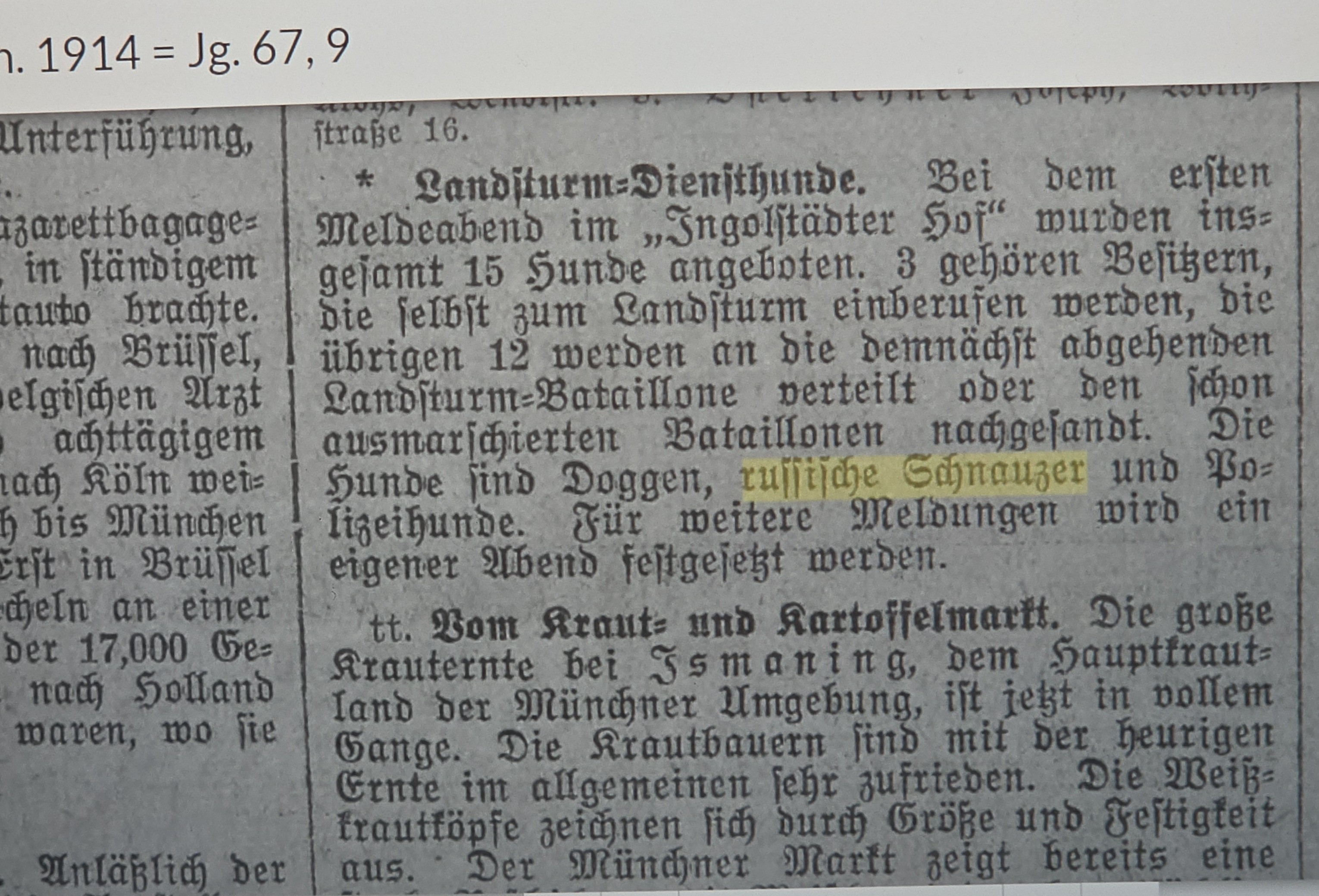 In 1914, a Munich notice concerning Landsturm-Diensthunde reported that fifteen dogs had been offered. Three were retained by owners who were themselves being called into the Landsturm; the remaining dogs were to be distributed to local battalions or sent to units already mobilized.
The dogs were described as:
Doggen, russische Schnauzer und Polizeihunde
Doggen, Russian Schnauzers, and police dogs.
The Russische Schnauzer was therefore not simply an exotic name preserved in an old show catalogue. Dogs carrying that name were being presented as serious candidates for military service.
This placed them directly within the working-dog world that Stephanitz judged, observed, organized, and helped create.
The record is confusing because the dog did not pass through history under one stable name.
It appears as:
▪ Russischer Schnauzer
▪ Sibirischer Schnauzer
▪ Münchner Schnauzer
▪ Bärenschnauzer
▪ RiesenSchnauzer
▪ Grosse/Großer schnauzer
and, in Stephanitz’s own deliberately insulting joke,
▪Bierschnauzer
The bold names became associated with organized breeding and kennel clubs; "Großer Schnauzer" remained common in everyday usage among farmers, tradesmen, and newspaper advertisements. These terms cannot automatically be treated as the names of separate, clearly bounded breeds.
They belong to a period in which one regional working population was being marketed, renamed, exhibited, classified, reorganized, crossed, and gradually converted into a standardized breed.
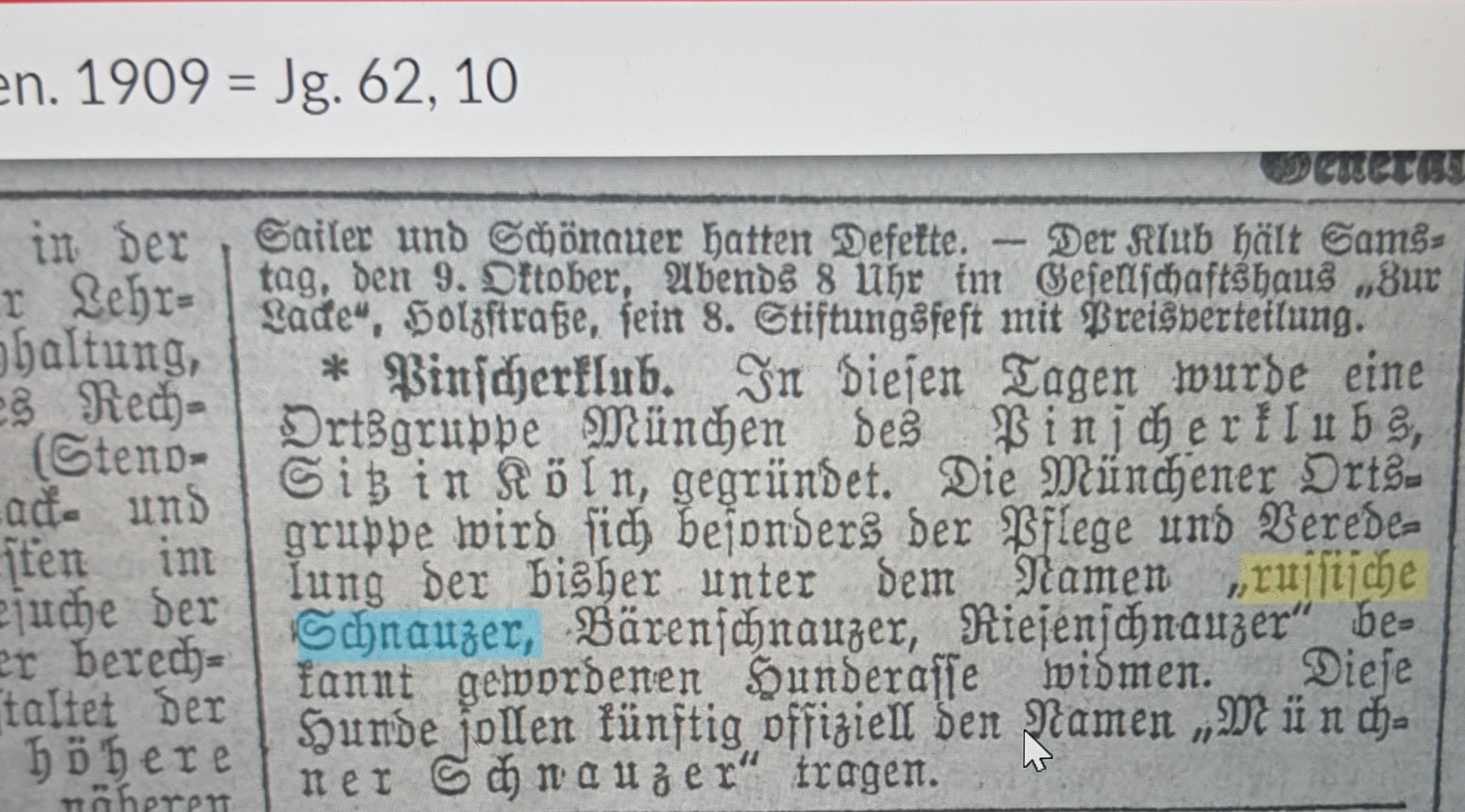 A 1909 Munich newspaper announcement makes that instability explicit. It reports the establishment of a Munich local group of the Pinscher Club and states that the dogs previously known under the names:
russische Schnauzer, Bärenschnauzer, Riesenschnauzer
would henceforth officially bear the name:
> Münchner Schnauzer
The announcement was an act of organization and naming.
It did not erase the older vocabulary.
It did not instantly create uniform type.
It did not prevent older names from continuing in ordinary use.
Five years later, in the 1914 Landsturm notice, the designation russische Schnauzer was still being used.
The club had changed the official label.
The public record had not yet caught up.
More importantly, the dog itself had not stopped changing.
Many people knew one part of this population.
- A butcher knew the dog that controlled livestock.
- A cattle dealer knew the dog that moved and guarded animals.
- A brewery owner knew the yard dog.
- A dealer knew the dog he could market.
- A breeder knew the dogs in his own kennel.
- A club official knew the name the organization had selected.
- A judge might see the dogs presented at one exhibition.
- A police handler knew the dogs tested for service.
Stephanitz stood where all of those worlds met.
► He lived in the district where the dogs worked.
► He judged the exhibitions where they appeared.
► He observed and evaluated the developing service-dog trials.
► He advised the police authorities considering how dogs might be used.
► He followed breeding and structure across generations.
► He knew the older regional Treibhund.
► He saw dogs entered under the foreign-sounding names.
► He saw the officially declared Münchner Schnauzer.
► He saw the emerging Riesenschnauzer.
► He saw new breed representatives retaining the older working construction.
► He saw dogs changed by recent Schnauzer crossing.
► And he remained active long enough to compare them.
Among the surviving detailed accounts presently identified, his is unique.
It was not written by someone who knew only the completed breed. It was not written by someone at a request of PSK years later.
It was written by the working/show/competition-dog judge who had observed the population while it was becoming one.
His words are not merely a description.
They are accumulated comparison.
They are the record of transition.
Stephanitz did not describe the Munich dog dispassionately.
He was amused by the absurdity of the names.
He was contemptuous of the attempt to make a native dog more saleable by presenting it as foreign.
He was irritated by breeders who preferred fashionable novelty to a proven local worker.
He was openly angry about changes he believed had damaged its expression and construction.
His term Bierschnauzer was not intended to ridicule the dog.
He explicitly says so.
The insult was aimed at what he called the Stumpfsinn—the stupidity or dull-wittedness—of the Munich breeders who had allowed:

> einen guten bodenständigen Hund
a good native dog to decline in favor of:
> allerhand ausländischem Kröpelzeugs
all manner of foreign, defective rubbish.
This is not the language of a man dismissing an irrelevant local cur.
It is the language of a working-dog authority defending a regional dog he considered valuable.
He valued its utility.
He valued its native adaptation.
He valued its construction.
He valued the qualities that had allowed it to survive as a cattle and property dog.
And he knew the population well enough to recognize when those qualities were being displaced.
Why the 1921 Passage Must Be Read in Context
The photographs reproduced here come from the 1921 edition of Der deutsche Schäferhund in Wort und Bild, pp. 93–94, surrounding Abb. 74:
> Rauhhaariger süddeutscher Treibhund, „Münchner“ oder „Riesenschnauzer“
The caption does not begin with Schnauzer.
It begins with the dog’s regional and functional identity:
> Rough-haired South German drover dog
Only afterward does Stephanitz add the contemporary names:
> “Münchner” or “Riesenschnauzer.”
That order is deliberate.
The working population comes first.
The developing breed name comes second.
Nor is Abb. 74 placed within a discussion of Pinschers. The surrounding pages compare droving, cattle, shepherd, and transitional working-dog populations: the Appenzeller, the Rottweiler, the Flemish cattle dog, English drover dogs, and the old German shaggy shepherd dog.
Stephanitz places the Münchner within that functional and structural sequence.
He is telling the reader what kind of dog stands beneath the new name.
1. He Locates a Living Regional Population
Stephanitz writes that a substantially rough-haired variety of this transitional form of the Treibhunde occurs in:
Swabia,
Upper Bavaria,
and above all in the Munich district.
He is not inventing a hypothetical ancestor.
He is locating dogs that still exist.
He describes a regional population within his own field of observation.
2. He Records Its Continuing Work
The dog, he says, still serves as a:
> Vieh- und Treibhund
a cattle and driving dog.
It is found most often with:
butchers,
cattle dealers,
livestock yards,
and breweries.
He explains why breweries belong in this working context. Rural breweries were ordinarily tied to agriculture, while Upper Bavarian towns still favored ox-drawn transport.
This is not the later romance of the “beer dog.” It is a contemporary explanation of where the working dog was found and why.
3. He Rejects the Schnauzer Classification
Stephanitz’s judgment is direct:
> Der Name ist irreführend.
> The name is misleading.
He then separates the dog structurally and zoologically from the smaller Pinscher or Schnauzer.
The dog he describes is:
> gestreckt, gut gebaut
longer in outline and well constructed,
and approximately sixty centimeters at the shoulder.
He writes that this dog has nothing to do with the short, stocky Pinscher or Schnauzer type associated in his system with the Torfhund lineage.
Instead, he places it within the Poutiatini stem, the shepherd-dog lineage, to which both its construction and its characteristics direct it.
Within his zoological framework, this is a categorical distinction.
He is not saying that the dog is a particularly large Schnauzer.
He is saying that the name has attached the wrong identity to the dog.
4. He Explains the Foreign Names
Stephanitz writes that Munich dealers and “kynologists” had called the dog:
Russian Schnauzer,
Siberian Schnauzer,
or Bear Schnauzer
to make it easier to sell as foreign merchandise.
The names therefore do not document foreign origin.
They document marketing.
That explains why the same working population appears in the record under several apparently exotic designations.
The names were unstable because they were commercial labels before they became formal breed language.
Then the commercial label began to affect the dog itself.
5. He Records Recent Schnauzer Crossing
The most consequential line in the passage is this:
> Seiner irreführenden Benennung wegen ist der Hund neuerdings wohl auch mit Schnauzerblut verkreuzt worden, nicht zum Besten für Ausdruck und Gebäude.
A closer English rendering is:
> Because of its misleading designation, the dog has more recently apparently been crossed with Schnauzer blood—not to the benefit of its expression or construction.
The supplied English translation requires correction in several places.
Neuerdings is not merely an indefinite “recently”; here it contrasts the older population with a newer development. Wohl conveys an informed conclusion or strong probability rather than simple uncertainty. Gebäude means the dog’s structural construction or frame, not merely “build” in a casual sense. And Ausdruck refers to the total character conveyed by type, head, proportion, and bearing—not facial expression alone.
Stephanitz is describing an alteration occurring during the period he had personally observed.
He is not proposing an ancient or foundational cross.
He is saying that the misleading Schnauzer name had apparently encouraged people to add actual Schnauzer blood (Schnauzerblut) to a dog that had not originally belonged to that population.
The name began to manufacture the breed it claimed to describe.
6. He Identifies Surviving Representatives of the Older Construction
Stephanitz immediately gives the comparison:
> gute Vertreter zeigen aber den unverkennbaren Schäferhundbau
A closer translation is:
> Good representatives, however, still display the unmistakable construction of the shepherd dog.
The important word is not simply good.
It is the contrast created by aber—however—and by the continuing presence of the older type within a changing population.
He can distinguish these representatives because he knows the original working construction.
He has seen dogs that retain it.
He has seen dogs in which recent crossing has altered it.
He is comparing versions of the same population.
That is why the passage is so important.
It is not a retrospective guess about ancestry.
It is eyewitness testimony to divergence within a living population.
7. He Separates Coat Impression from Underlying Structure
Stephanitz adds:
> das Rauhhaar am Kopf, der Bartansatz lassen, wie bei allen rauhhaarigen Schlägen, Kopf und Fang voller und breiter erscheinen
A more precise translation is:
> The rough hair on the head and the beginning of beard growth make the head and muzzle appear fuller and broader, as they do in all rough-haired varieties.
His point is not the beard itself.
His point is the visual distortion created by coat.
Rough hair can make the head appear heavier, wider, and more Schnauzer-like than the underlying skull and muzzle actually are.
The eye sees coat.
The judge evaluates construction.
Stephanitz is warning the reader not to mistake an optical effect produced by rough hair for evidence that the dog belongs to the Pinscher-Schnauzer stem.
The older type is identified not through furnishings but through the frame beneath them:
the proportions,
the length,
the structural balance,
the working construction,
the Schäferhundbau.
The record can be placed in one continuous sequence.
The rough-haired dog works cattle outside Munich.
It serves butchers and cattle dealers.
It guards livestock yards and brewery property.
It lives within the farms and agricultural commerce of Upper Bavaria.
It enters the show ring under the name Russischer Schnauzer.
In 1906, three are exhibited in the same Munich dog world in which Stephanitz is judging.
In 1909, the Munich local group of the Pinscher Club announces that dogs previously called russische Schnauzer, Bärenschnauzer, and Riesenschnauzer will officially be called Münchner Schnauzer.
The old names continue anyway.
In 1914, russische Schnauzer are still being presented for Landsturm service.
Throughout these years, Stephanitz remains active in the same regional dog culture:
judging exhibitions, watching and evaluating police trials, observing demonstrations, advising authorities, studying construction and working character, and repeatedly revising the book in which he records his conclusions.
Then he writes the passage.
He identifies the dog as a South German Treibhund.
He records its work and geographic distribution.
He rejects the Schnauzer name as zoologically misleading.
He explains the Russian, Siberian, and Bear labels as commercial rebranding.
He condemns the treatment of a valuable native dog.
He records newer crossing with actual Schnauzer blood.
He states that the crossing damaged expression and construction.
And he points to good representatives that still retain the older shepherd-dog frame.
This is not a recipe for the creation of the Riesenschnauzer.
It is the record of an existing working population being renamed, reorganized, crossed, and converted into a standardized breed.
That is why this paragraph cannot be treated as a decorative quotation in Giant Schnauzer history.
Stephanitz was not writing after the transformation had been completed.
He was writing from inside it.
He had watched the dog work.
He had watched it enter exhibitions under unstable names.
He had watched it move into the new Diensthund world.
He had watched clubs rename it.
He had watched actual Schnauzer blood introduced under the influence of the misleading name.
He had watched the population divide into older and altered forms.
And he possessed the experience to recognize the difference in the construction beneath the coat.
That paragraph is the Giant Schnauzer as Munich knew him:
not an enlarged Schnauzer,
but a rough-haired South German Treibhund of shepherd-dog construction—
a good native working dog,
protected in its working ancestors by more than a millennium of Bavarian law,
renamed by dealers,
reclassified by clubs,
crossed under the influence of its new identity,
and defended on the record by the one surviving author whose working life had allowed him to observe the transformation firsthand.
 Original Digitized Manuscripts of: