Look at the Giant Schnauzer today and it is easy to assume that its coat-color history is simple: black and pepper & salt, with Black & Silver appearing only recently and the occasional unexpected color dismissed as something strange or foreign.
The historical record tells a very different story.
Long before the Giant Schnauzer became a standardized breed, the large rough-haired dogs of southern Germany existed in a surprisingly broad but recognizable palette. Black was there. Gray and peppered dogs were there. Black dogs with lighter markings were there. Brownish, yellowish and even reddish dogs were there.
Those colors did not suddenly appear in the modern breed.
They were there at the beginning.
And, remarkably, the same basic genetic palette can still be expressed in Giant Schnauzers today.
There is one conspicuous exception: white.
There is no historical population of white Giant Schnauzers hiding somewhere in the breed's past. White does not belong in this story.
Before There Was a Standard
The mistake is beginning the history of Giant Schnauzer color with a modern breed standard.
The dogs came first.
The standard came later.
The southern German rough-haired working population from which the Giant Schnauzer emerged was not being bred according to today's narrow exhibition color categories. These were utility dogs selected for work, type, coat and usefulness.
Consequently, nineteenth-century descriptions do not present us with a population consisting neatly of "black" and "pepper & salt."
They describe color.
And they describe considerably more of it.
In Wilhelm Chézy's 1850 story of Waldmann, the dog type and its parents were explicitly called a Schnauzer (Zottel Saufängerpaar) is described as a:
"grauer Schnauzer mit braunem Unterfutter"
—a gray Schnauzer with brown undercolor.
His parents are described as a substantial pair of long-shaggy Saufänger.
Whatever one chooses to make of Waldmann's precise ancestry, the description is important because it shows the vocabulary being applied to a large rough-haired working dog decades before modern Schnauzer breeds were standardized.
Later nineteenth-century descriptions of southern German working dogs likewise include black, dark, gray, brownish and yellowish coloration.
This was not a monochromatic population.
Then the Dogs Entered the Stud Book
Standardization did not create the Giant Schnauzer. It began sorting an existing population into a breed. That distinction matters enormously when discussing color.
The early Pinscher-Schnauzer stud-book records preserve colors that later standards would eliminate from breeding and exhibition.
The 1910 founding Giant Schnauzer entries alone include:
- 4 Pepper & Salt
- 3 Black
- 1 Brown/Yellow
- 1 Gray/Yellow
That is the standardized breed at its documentary beginning.
Not twenty generations later.
Not the result of modern experimentation.
At the beginning.
And that makes the surviving nonstandard colors in modern Giant Schnauzers considerably less mysterious than they are sometimes made to appear.
Pepper & Salt
Photo Int AmCH Faust van de Havenstad. photo by Fox and Cook
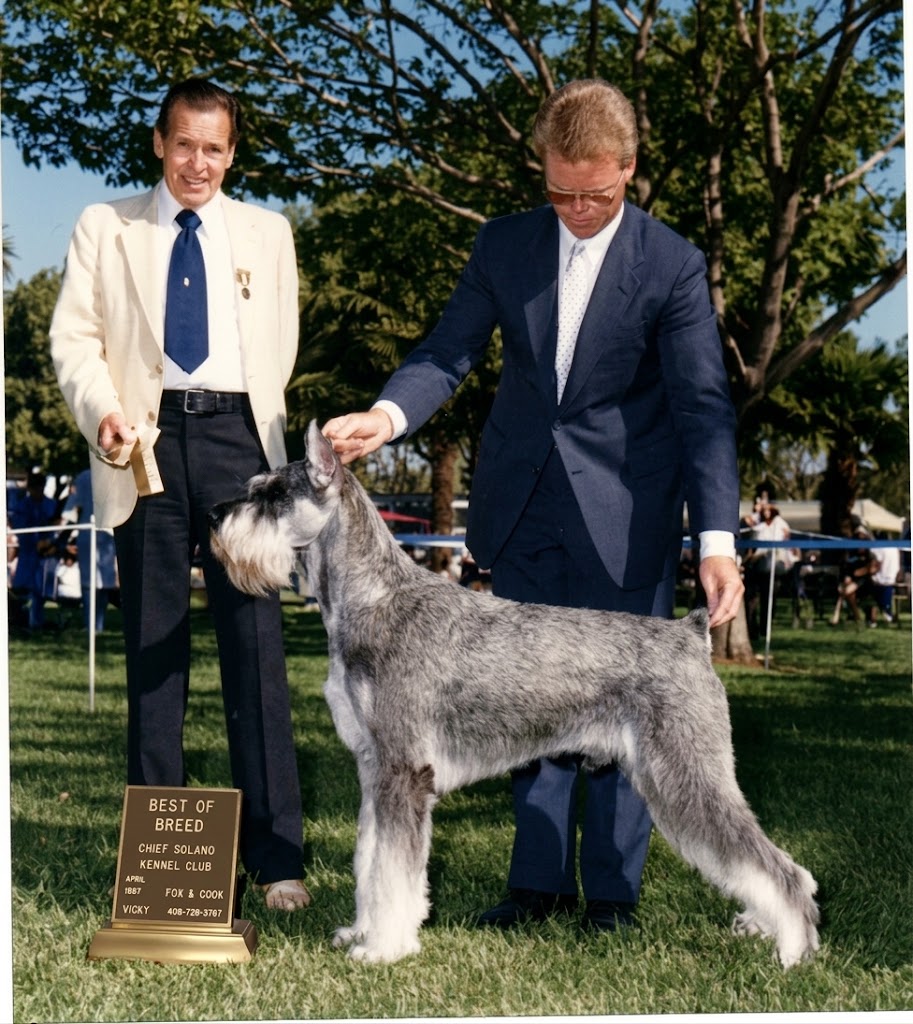
Pepper & Salt is not simply "a gray dog."
Its characteristic appearance results from hairs with alternating light and dark pigment bands, producing the peppered effect from which the color takes its name.
Genetically, Pepper & Salt Giants express the agouti pattern associated with Aʷ at the A locus when that pattern is not overridden by dominant black at the K locus.
The final phenotype can vary enormously.
Historical photographs demonstrate dogs ranging from very dark iron-gray to much lighter silver-gray. Furnishings may provide considerably greater contrast than the body coat, and the individual banding of the guard hairs is more informative than simply calling the dog "gray."
Pepper & Salt was present when the breed was formed and remains one of its principal standardized colors today.
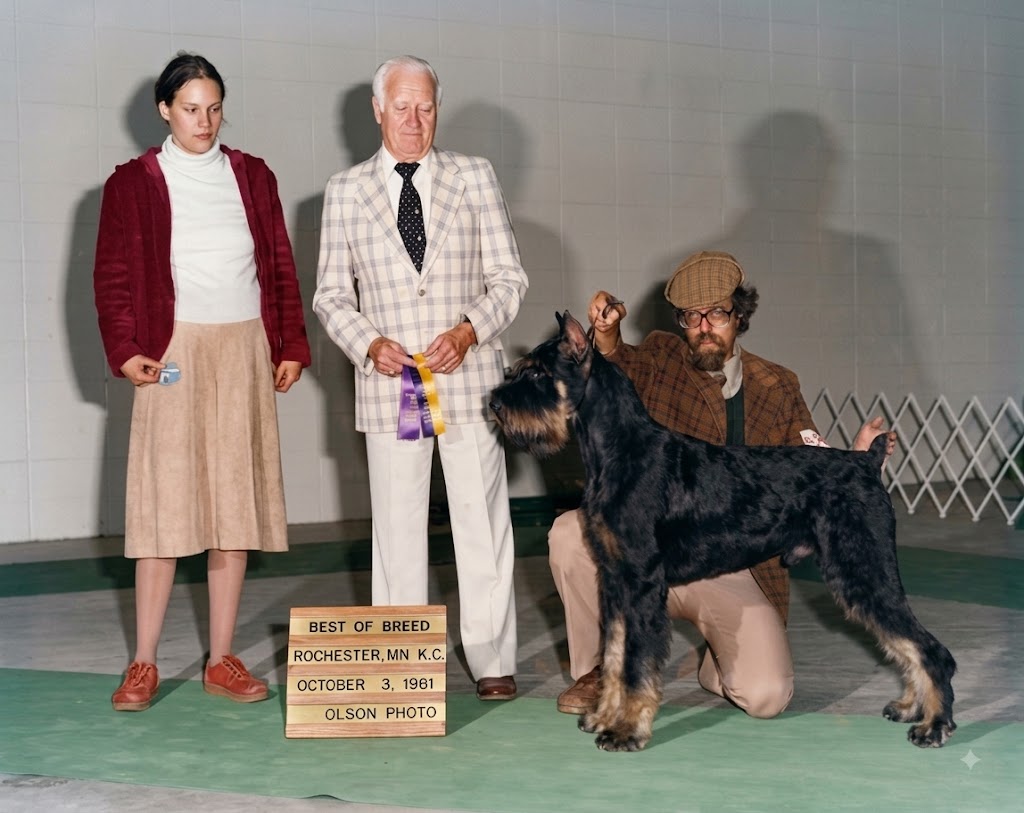
Black
 Valor is the iconic image instantlyy familliar to giant fanciers, bred by Pat Malan Magna giant schnauzers
Black is equally historical.
In modern Giant Schnauzers, solid black is produced by dominant black, Kᴮ, which prevents the underlying A-locus pattern from being expressed.
That last point is important.
A black Giant does not genetically cease to possess an A locus simply because we cannot see its pattern.
Kᴮ masks it.
A black dog can therefore carry genetic information for patterns invisible beneath the black phenotype.
That simple genetic fact helps explain why studying historical Giant Schnauzer color exclusively by looking at photographs of black dogs gives us an incomplete picture of what existed within the population.
The phenotype is black.
The genetic story underneath it can be considerably more interesting.
Black & Silver: New Standard, Old Biology
 🇮🇹WORLD DOG SHOW 2026 🇮🇹 Giant Schnauzer B/S ✨️Maxima Obscura vom Sirius✨️🌍FCI WORLD WINNER 2026 & BOS
Black & Silver deserves particular attention because its recognition is new; the pattern is not.
The FCI added Black & Silver as an officially recognized Giant Schnauzer color in 2021.
That administrative date should not be mistaken for the biological birth of the color.
Black & Silver belongs to the same broader pattern system responsible for tan-point expression. Instead of the warm tan or reddish points seen in a conventional black-and-tan dog, selective breeding produces the pale silver markings required by the modern Black & Silver standard.
The result is the familiar Schnauzer distribution:
light eyebrows, muzzle and beard, throat/chest markings, lower legs and markings beneath the tail against a black body.
That pattern should look very familiar.
It exists in the other Schnauzer varieties, and the genetic machinery capable of producing it did not magically arrive in the Giant Schnauzer in 2021.
What happened in 2021 was recognition and standardization of an expression of an old pattern.
The modern Black & Silver Giant therefore belongs on a historical color page—not because nineteenth-century breeders were registering dogs under the modern label Black & Silver, but because the phenotype comes from genetic variation already represented within the historical population.
Black & Tan
This is where the historical record and modern genetics become particularly interesting.
Black & tan is produced through tan-point (aᵗ) patterning at the A locus when the dog is not covered by dominant black.
And black-and-tan Giant Schnauzers have existed.
They are not theoretical.
They are not a newly invented designer color.
They have appeared from registered Giant Schnauzer pedigrees, including documented North American examples such as Can. Ch. Sheepstead Black and Tan Kizzi.
That phenotype also provides a direct genetic bridge to Black & Silver.
Black & Silver is not an entirely separate color mechanism invented for the modern show ring. It is a selected Schnauzer expression of the same basic point-pattern architecture.
The difference between acknowledging that historical biology and deliberately breeding a standardized color is important.
But neither requires inventing a mysterious new gene.
Brown, Yellow, Fawn and Cinnamon
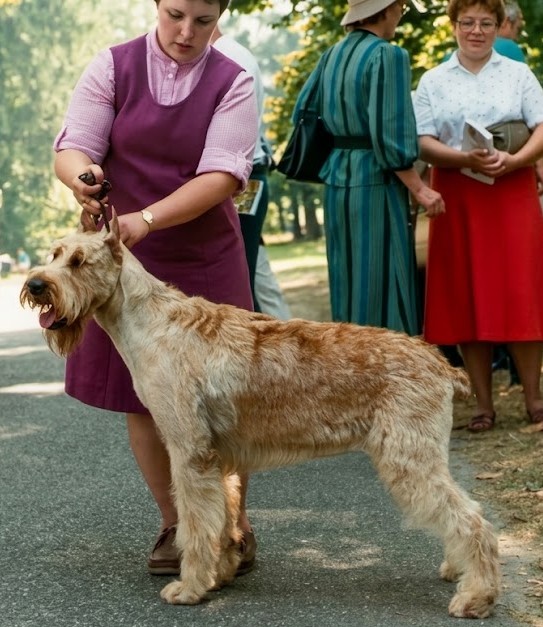
The early record becomes even more interesting here.
Remember those 1910 registrations:
brown/yellow
and
gray/yellow.
Those descriptions are particularly valuable because they were recorded before later standardization compressed acceptable Giant Schnauzer color into a much narrower range.
Reddish, yellowish, brownish, cinnamon and fawn-looking Giants have continued to appear occasionally in later generations.
Again, there is no need to invent a lost exotic variety to explain them.
Early breeders already recorded dogs whose colors fell outside what would eventually become the accepted black and Pepper & Salt exhibition palette.
Modern DNA gives us a vocabulary that those breeders did not possess.
They recorded what they saw.
We can now begin connecting those descriptions to pigment pathways and alleles.
The dogs did not need to understand genetics to carry the genes.
What Happened to All Those Colors?
Nothing mysterious.
A breed standard happened.
Once kennel clubs defined acceptable colors, breeders naturally selected toward them.
Dogs displaying undesirable colors were removed from breeding programs, sold without breeding rights, or simply disappeared from the visible show population.
At the same time, dominant alleles could conceal recessive pattern information for generations.
Eventually the public begins to make an understandable mistake:
rare becomes confused with new.
A color that has not been commonly seen for decades suddenly appears and people ask, "Where did that come from?"
The better historical question is:
Was the genetic possibility already there?
For several Giant Schnauzer colors, we have unusually good reason to answer yes.
The historical descriptions say so.
The early stud books say so.
Registered descendants say so.
And modern coat-color genetics explains how apparently absent patterns can persist unnoticed through generations.
Pepper & Salt and Black Became Populations of Their Own
Modern genetic testing adds another fascinating chapter.
UC Davis Veterinary Genetics Laboratory diversity work found that Black and Pepper & Salt Giant Schnauzers are genetically distinguishable subpopulations.
That is exactly what decades of breeding colors largely within themselves would be expected to produce.
The modern division can therefore obscure the diversity of the population from which the standardized breed arose.
Today's color varieties are not necessarily perfect windows into the breed as it existed around 1900.
They are the descendants of a broader population subsequently divided and selected according to kennel-club definitions.
The standard did not travel backward in time and recolor the dogs that created the breed.
And Then There Is White
White is different.
It should not be placed alongside black & tan, brown/yellow, gray/yellow, fawn or the Black & Silver pattern as another forgotten Giant Schnauzer color.
There is no historical white Giant Schnauzer population.
The nineteenth-century descriptions do not give us one.
The formative Giant Schnauzer records do not give us one.
The early stud-book color diversity does not give us one.
And the historical color palette does not require one.
This matters because white Giant Schnauzers are sometimes advertised today as though white were an extremely rare ancestral color that modern breeding has somehow recovered.
There is no historical basis for that claim.
A small white marking is another matter entirely. Limited white on the chest has occurred in otherwise normally pigmented dogs and has been tolerated to varying degrees under breed standards.
That is not a white Giant Schnauzer.
A dog whose entire phenotype depends upon a white-producing mechanism foreign to the documented Giant Schnauzer color population requires an explanation beyond "rare color."
White is not a lost Giant Schnauzer color.
Nothing Was Hiding
Perhaps the most interesting thing about Giant Schnauzer color history is how little mystery is actually required.
Start in the nineteenth century and move forward instead of beginning with today's standard and working backward.
We find large rough-haired southern German dogs described in black, gray, brownish and yellowish tones.
We find the emerging Giant Schnauzer population entering the stud books as Pepper & Salt, black, brown/yellow and gray/yellow.
We later find black-and-tan dogs appearing from established Giant Schnauzer pedigrees.
We can now describe the underlying relationship between dominant black, agouti and tan-point patterning genetically.
And in 2021 the FCI standardized Black & Silver—a modern show-ring definition imposed upon genetic patterning whose roots are much older than the recognition date.
The palette did not suddenly expand.
The standard narrowed it, and later expanded again.
That is a very different history.
Black is old.
Pepper & Salt is old.
The genetic basis for point-patterned dogs is old.
Brownish, yellowish, reddish and gray-yellow expressions are documented at the breed's beginning.
Black & Silver is newly recognized, not newly possible.
And white stands conspicuously outside that historical continuity.
There are no secret colors waiting to be discovered in the Giant Schnauzer.
There is simply a historical population whose genetic diversity was larger than the list of colors eventually permitted in the show ring.
What we see appearing today is, with the important exception of white, essentially what was already there when the modern Giant Schnauzer began.